Chapter 1
- Objectives, In this chapter we will
- Look for a grand overview of data communications and networking
- Define a number of terms
- Discuss Data Communications
- Discuss Data Communications Networking
- Discuss Protocols
- Discuss Protocol Architecture
- Discuss Standards
- Some statements:
- In the 60's telephone (voice ) communications networks
- In the 60's computer ( data ) communications networks
- In the 70's these merged.
- "There is no fundamental difference between data processing
and data communications"
- "There are no fundamental differences among data, voice and
video communications"
- "The distinction among single-processor computer, multiprocessor
computer, local network, metropolitan network and long-haul
network has blurred"
- A Communications Model.
-
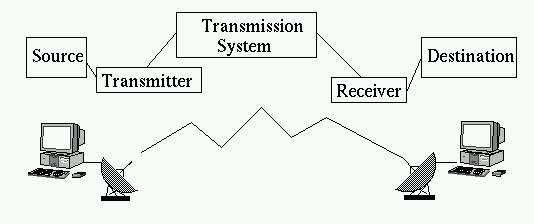
- A Source generates data to be transmitted.
- Telephone
- Networked camera
- Computer
- A Transmitter encodes the data to be data into a
transmittable form
- Modem
- Network Card (coax based)
- Network Card (optical)
- A Transmissions System transports the encoded message
- This may be very complex.
- A Receiver accepts the signal from the transmission system
and decodes it into data
- A Destination Takes the data.
- Tasks associated with networks:
- Transmission System Utilization - the percentage of the
transmission system being used, must be maximized.
- Multiple users are supported simultaneously through the use
of multiplexing.
- Congestion must be controlled to satisfy demand
- Signal Generation or encoding the data into a form that
can be sent over the transmission system.
- A device that interfaces with the transmission system
must do this.
- Transmissions must be synchronized
- Errors must be detected and possibly corrected or
at least fixed.
- The address or location of the destination must be determined.
- and a route or path to that address must be found
- Disrupted transmissions should be recoverable
- Communications should be secure
- Facilities need to be in place to allow for
Network Management
- Data Communications (Chapters 3- 8) deals with turning data into
a signal, placing that signal onto the transmission system, sending
the data through the transmission system and removing it from the
transmission system.
- A new look at our model.
- A message (in text) is typed in at the source. m
- This information is encoded in binary data g(t)
- The transmitter turns this data into a signal s(t)
- The signal (s(t)) is place in the transmission system.
- On the other end a signal r(t) is received, we hope
that r(t) = s(t), but it may not be.
- The signal r(t) is turned into data g'(t). In some systems it is the responsibility of the receiving system to check to see if g'(t) =g(t)
- The data g'(t) is turned back into a message m'
- With email, file transfer and such, m must be the same as m'
- With voice and video, m' must be close to m, but they need
not be identical.
- The message can possibly be transformed text->digital data -> analog signal -> digital data -> text.
- Other examples are possible (video, voice, telemetry data, ...)
- Data Communication Networking
- Direct point to point connections (like a parallel printer connection) are rare
- Most communications involve a network.
- WAN - wide area network
- Long distances 10s to 1000s of kilometers
- Crossing of public right-of-ways
- Transmission media and hardware are owned by communications companies
- No concern with data content, only data movement.
- Typically
- Circuit switched.
- A single path is established and all data flows through it.
-
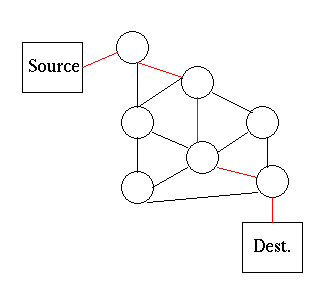
- This is called a dedicated circuit.
- The phone system.
- Packet switched.
- Packets are sent independently
-
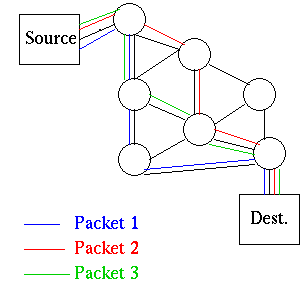
- Each packet may take an independent route
- This is common in computer networks.
- In addition
- Frame Relay
- This is a modified version of packet switched networks.
- An attempt is made to reduce overhead in the system.
- ATM
- Evolved from circuit switching
- Packets are of fixed size
- Still a circuit switching network
- Quality of service and bandwidth addressed
- ISDN
- Integrated Services Digital Network
- Designed to replace telephone networks
- LAN - Local Area Network
- Scope- building, floor, or campus
- Much faster than an WAN
- The organization usually owns everything
- Traditionally broadcast, but switching is here too
- Ethernet, ATM, Fibre Channel
- Protocols and Protocol Architecture
- We are familiar with application protocols (FTP, HTTP, ...)
- These often assume a valid network
- A protocol is a set of rules governing the exchange of data
between two entities.
- At the network level a protocol includes:
- Syntax - data formats and signal levels
- Semantics - control information
- Timing - speed matching and sequencing
- In network communications, there are many segments that can change:
- Underlying transmission system (physical network)
- Protocol running on the local network
- Connections to remote network
- It would be bad to be forced to rewrite each application for each
variation.
- ftp without a network
- ftp for ethernet over coax, twisted pair, fiber, 10,
100, 1000 MB.
- ftp for atm 25mb, 155mb, 600mb, ...
- ie each protocol at every level.
- For that reason, we have developed a hierarchy of protocols or
a protocol architectures.
- These are generally a layered approach.
- Separate sub-tasks are implemented as a layer.
- High level applications rely on the underlying levels and
only deal with their own protocol.
- User authentication
- File exchange
- ...
- An example three layer model
-
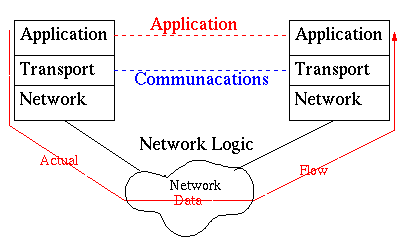
- Network Access Layer
- Concerned with exchanging data between computer and network
- Network addresses
- Network services (quality, bandwidth)
- This is a network dependent layer
- Transport Layer
- Concerned with the message.
- All data in order.
- All data present.
- No knowledge of the contents of the message or of
the function of the network.
- Application Layer
- The logic of the application
- There are two addresses involved here.
- Each machine has its own address
- Applications on machines have an address too
- Multiple applications can be running on a single machine
- Web server
- ftp server
- Tenet server
- Client for each of these
- These are called service access points (SAP)
- Also known as ports.
- Pigeon hole mail box system.
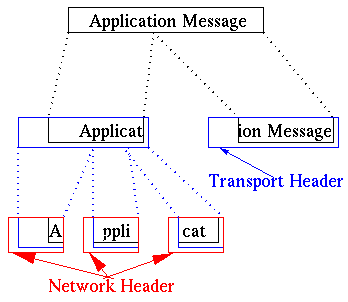
- At each layer, data is encapsulated into a packet.
- Also called a protocol data unit (PDU)
- A packet contains a payload
- Also header and trailer information
- Transport Layer Header (Examples)
- Destination SAP
- Sequence Number
- Error Detection Code
- Network Layer Header (EXAMPLES)
- Destination Computer Address
- Source Computer Address
- Priority Request Information
- Packets may be broken down further at lower levels.
-
- There are two protocol architectures that we will study:
- The real world uses the TCP/IP model
- Developed by the DOD through DARPA (Defense Advanced Research Projects Agency)
- Consists of five levels
- Application Layer
- Host to Host (Transport) Layer (TCP)
- Internet Layer (IP)
- Routing data between networks
- Router (or gateway) a connection between two networks
- Network Access Layer
- Physical Layer
- The interface between the computer and the network.
- No formal definition of the levels
- We will look at the pieces all semester, but in chapters 15 and 16
- The theoretical world uses the OSI model
- Open Systems Interconnection model.
- Developed by the International Organization for Standardization
(ISO)
- Studied thoroughly, Mostly Academic these days.
- Seven Layers
- Application
- Presentation
- Mechanism for data representation
- Session
- Establishes, manages and terminates sessions
- Transport
- Network
- Data Link
- Physical
- We will look at these architectures in chapter 2.
-

- Standards
- As you can guess, without standards, this whole thing would fall apart.
- Communications companies have long accepted standards
- Computer companies have not.
- Standards
- Assures that there will be a large marked for a product
- Allow multiple vendors to participate, give the consumer
more flexibility
- Freeze technology at the standard.
- Inhibit new growth. Why develop new ideas when they must be
shared (standards) and other companies will benefit from your
work.