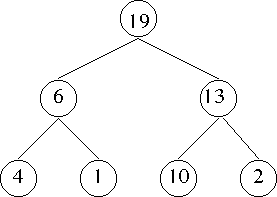
- It is a binary tree
- With the following properties
- All levels except the last are full, and the last is filled from the left to the right.
- This is know as essentially complete
- There are at most 2l nodes at level l.
To Prove: There are at most 2l nodes at level l in a binary tree.
By induction:
Prove true for the base case
  At level 0 there are at most 20 = 1
Strong Induction: Assume true for k
  At level k there are at most 2k nodes.
Prove for k+1
  To show:  At level k+ there are at most 2k+1 nodes.
  By the inductive step, there are at most 2k nodes at level k.
  Since it is a binary tree, each node at level k may have two children, so
  there are at most 2*2k nodes at level k+1.
  Since 2*2k = 2k+1 the proof is complete.
- it is also easy to show that there are a maximum 2h+1-1 nodes in a complete binary tree.
- And that a binary tree is at least ⌊lg(|V|)⌋ high
- All levels except the last are full, and the last is filled from the left to the right.
- The second property is the heap property
- The key for any node is greater than the key for all descendant nodes.
- Leaf nodes automatically meet this property.
- And it is recursive, so sub-heaps are also heaps.
- This is a maximum heap, the maximum is at the top.
- We can also require a minimum heap where the minimum is at the top.
-
- let n = |V|
- Insert an item into the heap
- This should be O(lg(n))
- Because we need to maintain the heap.
- Delete the top item from the heap
- This should be O(lg(n))
- Because we need to maintain the heap.
- Normal observers such as height, isEmpty, size..
- Should all be maintained as aux data.
- And should all be O(1) time.
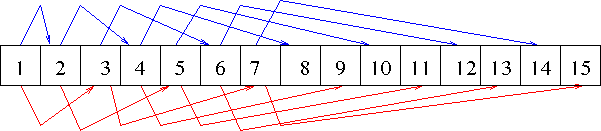
- Observe the following properties of an array
- Place the root at A[1], I know this is a FORTRAN thing, but ...
- But it makes the computation easier
- And we can always subtract 1 from all of the computations below.
- So now consider the relationships between index and children:
- A left child could be at position 2, (or 1*2)
- A right child could be at position 3 (or 1*2+1)
- For the node at position 2
- The left child is at 2*2 or 4
- The right child is 2*2+1 or 5
- For the node at position 3
- The left child is at 3*2 or 6
- The right child is 3*2+1 or 7
- For node 7, the parent is ⌊7/2⌋ = 3
- For node 6, the parent is ⌊7/2⌋ = 3
-
-
PARENT(i)
- return i/2
- return i*2+1
- return i*2
-
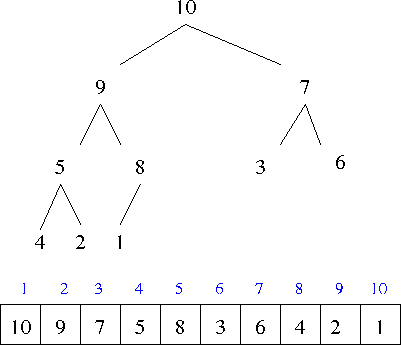
- Place the root at A[1], I know this is a FORTRAN thing, but ...
- An important routine is HEAPIFY
- Takes an array A and a position i.
- Assumes that the sub-heaps are heaps
- But the item at position i might not be.
-
HEAPIFY(A,i)
- l ← LEFT(i)
- r ← RIGHT(i)
- if l ≤ HEAP_SIZE(A) and A[l] > A[i] then
- largest ← l
- else
- largest ← i
- if r ≤ HEAP_SIZE(A) and A[r] > A[largest] then
- largest ← r
- if i ≠ largest then
- SWAP(A[i],A[largest])
- HEAPIFY(A,largest)
- What does this do?
- Are we sure it is right?
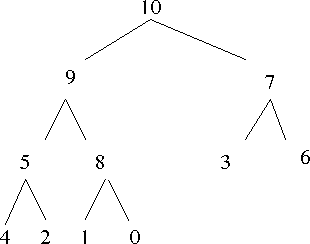
- Consider HEAPIFY(A,1)
-

- Call 1 will swap 0 and 10 and call HEAPIFY(A,2)
- Call 2 will swap 0 and 9 and call HEAPIFY(A,5)
- Call 3 will swap 0 and 8 and call HEAPIFY(A,11)
- Call 4 will exit due to HEAP_SIZE()
-
-
- What is the performance
- BUILD_HEAP will take an array and turn it into a heap.
-
BUILD_HEAP(A)
- HEAP_SIZE(A) ← length[A] // perhaps an abuse of notation.
- for i ← ⌊length[A]/2⌋ down to 1 do
- HEAPIFY(A,i)
-