Introduction to Sequential Circuits
Notes
- This is chapter 6 of Carpanelli.
- In conbinational logic the outputted is completely determined by the input.
- In sequential logic
- there is a state, or current status of the circuit
- Input will change the stat
This is exactly what we have seen with registers.
- Sequential logic = circuits with memory
- Frequently sequential logic involves some form of synchronization
- This is usually done in the form of a clock
- A clock is a source of a periodic wave, or a periodic translation between 0 and 1.
- A single cycle is the time it takes for one period
- This is measured in time periods like microseconds, nanoseconds, picoseconds
- The frequency of the clock is the number of cycles per second.
- This is also known as Hertz, Hz (or cycles per second)
-
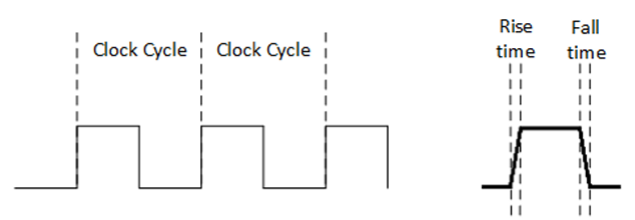 (From the book)
- The image is an idealized clock output.
- The actual output is not square and does not instantly change from 0 to 1 and 1 to 0.
- The place where the clock changes from 0 to 1 is called the leading edge.
- The place where the clock changes from 1 to 0 is called the trailing edge
- Clocks have a duty cycle
- This is the percent of a cycle where the value is high.
- In the picture it is 50%, but it doesn't have to be.
- Clocks are built at an electronic level outside of our scope of study.
- But if you wish, Ben Eater builds a clock for his 8 bit computer here.
- frequency = cycles/second
- period = seconds/cycle